Showing posts with label Royal Sussex. Show all posts

Thursday, June 10, 2010

The maternity ward at the Royal Sussex County Hospital, Brighton

Please note that this blog entry (as well as previous entries) is based on our experience of NHS services at the Royal Sussex, not private healthcare.

If the care and service in the delivery suites at the Royal Sussex County Hospital was beyond professional – my wife's experience of the maternity ward on the 12th floor was disappointingly average.

That's not to say it was unprofessional or particularly poor. Far from it. But following such an overwhelmingly positive experience on the 13th floor, the care and attention on the ward below was glaringly functional.

First off, the temperature, for obvious reasons, is kept incredibly hot. So much so that my wife knew instantly that she would not be able to sleep. This was immediately stressful following her labour, delivery and aftercare. Moreover, the maternity ward seems to be full of four-bed rooms, meaning that if your own newborn doesn't wake you up, there is a strong chance someone else's will.

In my wife's case, both the temperature combined with three noisy neighbours (not their fault, of course) made for a sleepless night. This was exacerbated by her struggles to breastfeed and the general insecurities that come with being a new mum. By the time I arrived back at the hospital in the morning, my wife was exhausted and emotional.

With that in mind, we wanted to get her home as soon as possible. However, the team on the 12th floor would not allow us to leave unless my wife could demonstrate her ability to breastfeed. I'm not sure how crucial this is, given the fact that babies can be fed formula if breastfeeding fails; but I'll give the NHS the benefit of the doubt here – I guess it is sensible to see if a woman can breastfeed and offer her tips and advice if this is failing.

The problem is that my wife was so tired and it was still so hot in the room, that she was becoming more and more agitated and less and less likely to be able to breastfeed properly. It felt like we were trapped there unless my wife could 'perform'.

Every time we asked to leave, we were told my wife would need to be checked on her breastfeeding skills. We would wait 45mins and no-one would come to check (clearly, the nurses are very hard-working and I do not doubt they would be much more attentive given the right resources) – during which time my wife would have fed the baby, so by the time someone arrived the baby wasn't interested and the whole process would start again.

I arrived at 9am to take my wife home, and we eventually left at about 3-4pm. We were both tired and stressed by the situation but I guess we felt as though the team had our baby's best interests at heart. The staff were always polite and kind and did offer helpful tips – it was just that my wife was too exhausted to really care. Also, my wife was fed well and there was always water on offer and the level of care was decent.

Due to the delays, I long overstayed the visiting hours and the staff, to their credit, did not give me any hassle. In typically masculine (and reductive) fashion, I may well have told them where to go if they had; but luckily the situation didn't arise. There was one wobble when I had to nip down to the car to put more money in the meter and asked prior to leaving if I would get back in – I was told it would be fine. But when I got back up the tower, a different nurse told me I couldn't enter as it wasn't visiting hours– she backed down when I said I was taking my baby home (at that point this was by no means guaranteed, but there was no way I wasn't getting back to my wife).

Nothing that happened on the maternity ward was enough to take the shine off our whole experience. It's just that if you are staying overnight on the maternity ward, expect just that – a typical NHS ward experience. Compared to the sterling efforts of the midwives one floor up, this seems more of a disappointment than it should.

Finally: Dads, the same parking issues apply when you are picking your child up as when you are taking your wife to give birth. I guess the four-hour parking meters on the streets running south from Eastern Road are even more handy if you are guaranteed a swift exit. If not, you may well have to put more money in the meter or move your car. As always, if there are spaces in the hospital car park, go for it. Park as close as you can, as the car-seat with baby can get heavy after a while. If you have a car-seat that fits onto the pram, then put the baby in the seat, attach it to the pram and wheel the whole lot from the ward to the car – I forgot to do this and was knackered by the time I got the car-seat back to our vehicle on Eaton Place.

The same issue about people smoking at the foot of the tower at the car park exit hold true. You will be carrying your newborn child past people smoking where they shouldn't and it is disgusting, inconsiderate and offensive. There is little point asking them to stop – there are usually five or six smokers and they are already smoking in an area with prominent “No Smoking” signs on display. Moreover, who knows what health- or family-related issues these smokers are trying to deal with? Rather than challenge them, it seems sensible to pressure the Royal Sussex to actually enforce their No Smoking policy and/or provide somewhere else for smokers to gather.

I might blog a bit more on this topic. Not necessarily smoking per se, but that and the many other moments of inconsideration that you battle on a daily basis when you have a baby – (NB, this blog has now been written).

Wednesday, June 09, 2010

Having a baby at the Royal Sussex County Hospital, Brighton

Here's a quick summary of what you can expect based on my experience with my wife at the Royal Sussex four weeks ago.

The quick solution to the parking problem is to do a recce long beforehand. Drive around the hospital to get your bearings and check out the roads nearby – there are plenty of spaces with 4-hour parking meters within easy walking distance on Eaton Place, Chesham Street, Sudeley Place and other roads heading south from Eastern Road. You'll be aiming for the 12th and 13th floor of the Thomas Kemp tower (where the delivery rooms and maternity wards are), so I found it best to park on Eaton Place whenever visiting the hospital. It means you can walk straight across Eastern Road and up Bristol Gate, then take a left into the hospital. If you cut across A&E, up the stairs on the right and continue up the ramp where cars go to park, you'll be able to access the tower lifts immediately. I found this much quicker than going into the main hospital entrance on Eastern Road and navigating all the various corridors and lifts of the hospital buildings themselves. (If you remember, this is not the case for the scan department, where you'll want to be closer to the main entrance.)

One gripe here is that, despite lots of 'No Smoking' signs at the bottom of the tower, there are always handfuls of people smoking cigarettes. I find it disgusting that people smoke in the exact areas people will be passing through with their newborn babies – and awful that the hospital allows them to do so.

On the day in question, I have to confess that my wife and I were dropped off by my mother-in-law, who stayed long enough to confirm that my wife was definitely in labour and not going anywhere, before driving back home and leaving us to it. I do recommend this option as it means you don't have to worry about parking at all until after the birth (you can get a bus or taxi home from hospital after the delivery, to get your car).

So, to the birthing experience. My wife had painless contractions on the Saturday night. By 3am on Sunday morning they had become uncomfortable. I was reluctant to ring in at that time, (being all blokey I was worried about what to say) so my wife rang in – we weren't yet ready to come in, though staff on the phone were patient, kind and helpful. We went for a walk along the seafront, had a snack and then rang in again as the contractions were slightly more uncomfortable – still not time. We had a roast dinner, and contractions became more powerful, though still not particularly regular (sometimes there were three in 10 minutes, other times three in 20 minutes). By 5pm, we'd had enough and went to the hospital.

The midwife we encountered on the 13th floor seemed mildly irritated that we hadn't rung in, but quickly found us a room to wait for someone to examine us. After about 50 minutes, a midwife came in to examine my wife, asking plenty of questions about contractions and our recent experience. After the exam, the midwife said: “Well, you're not going anywhere”. My wife was 4-5cms dliated.

We were looked after from 6pm-8pm by Laura, an exceptionally brilliant professional, who explained everything that she was doing throughout the earlier stages of my wife's labour. From 8pm, Laura began preparing for the shift change that would see us looked after by Kylie, a fantastic midwife who stayed with us from 8pm until our baby was born and during the immediate after-care. Both midwives were incredible and an asset to the Royal Sussex and the NHS.

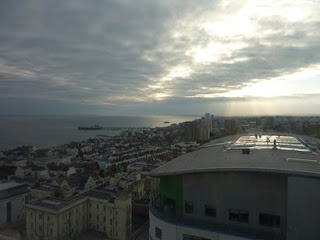
The room my wife was initially examined in turned out to be the same room we would have our baby in (unless the birthing pool was available – see below). It had a fantastic view of the West pier, seafront, the Downs and beyond. We were allowed to move furniture around (within reason), set-up our battery-powered speakers and iPod, and place all the bags we needed.

My wife was monitored in between and during contractions and Laura happily looked at the birth plan we presented her with. My wife was offered a bath, which she took. She had also told Laura that she would like the birthing pool if it was available. There is only one pool at the RS – luckily it became free at about 9pm and my wife was delighted. We moved into the pool room and set-up our iPod and speakers there – at which point Kylie took over and we thanked Laura.

My wife immediately felt at home in the pool. The water soothed the pain of her contractions a little and generally helped to relax her. For me, the pool room was a bit more relaxing, though leaning over the pool itself was a little difficult on the back (I say this fully aware of the more severe discomfort experienced by my wife).

My wife's contractions became steadily more powerful and painful. She requested gas and air, which helped hugely initially but became less soothing as time wore on. Naturally, when the midwife was out of the room, I had a go on the gas and air and can report that it was indeed a little like being drunk, but wears off very quickly (I had two 'tokes'). The rest is a bit of a blur.

The main thing I put into practice from what I learnt at the NCT lessons, were positions to help soothe my wife, along with rubs and strokes. My wife really appreciated this, along with vocal encouragement and quiet echoes of what the midwife was telling her. Kylie was fantastic at helping my wife overcome a particularly strong contraction or one that brought along a new type of pain that scared her. I have to say, I failed to spot the 'transition stage', though later asked the midwife and she told me exactly when it happened: when my wife was asked about more pain relief.

At one point, my wife got out of the pool (I forget why) and the contractions she experienced out of the water were much stronger and more painful than those under the water. Once back in the pool, Kylie told my wife that if she wanted the next stage of pain relief (pethidine or an epidural), she would have to come back out of the water and stay out – this was indeed the 'transition stage'. The fact that she would have to get out of the water was enough to put my wife off so much that she vowed she wasn't ever coming out of the pool again until it was over.

Throughout the painful contractions, midwife Kylie was supportive, sensitive and empowering, offering precisely the right words and wisdom that helped my wife summon the strength to deliver the baby herself.

At 11.52pm, our daughter Eve was born in the pool and immediately placed onto my wife for skin-to-skin contact for about 10 minutes. I was permitted to cut the cord and then I was given the baby while my wife received some immediate aftercare outside of the pool.

This aftercare continued back in the original delivery room we had been allocated and, if I have one gripe, it is that I was not initially told how long this would take. I was asked to wait outside by my wife. At one point, an orange light that looked like an emergency light came on and another midwife rushed into the room. Naturally, I was terrified and suffered a traumatic 10 minutes until the guy came out, saw my expression, and assured me everything was fine.

That said, I cannot fault the professionals on the 13th floor at the Royal Sussex. My wife had a relatively easy labour (in comparison to many women), and while I attribute much of this to my wife's attitude and willingness to do Yoga and learn about hypno-birthing and other forms of self-support; much of her positive experience and outcome I put down to the work of Laura and Kylie, midwives par excellence at the Royal Sussex. Thanks very much.

I will write a further blog on the maternity ward experience, where my wife stayed the night after our daughter was born.

Tuesday, March 23, 2010

Scans at the Royal Sussex County Hospital


If you're the kind of bloke that doesn't think he needs to be present at the baby scans – I'm not sure anything I write will change your mind. If you haven't taken the time to think about how amazing it might be to see your offspring for the first time and you don't think your partner needs support or would like to share the experience with you...then you may well be better off at work, down the pub or playing sport.

For those of you excited by the idea of going to the scan, here's a quick summary of what you can expect based on my experience accompanying my wife to the Royal Sussex.

I'm sure you're already aware of the parking situation at the RS and, yes, it is bad. I've heard anecdotes from staff, patients and visitors that the hospital car park is often full by 8am, leaving little chance for casual visitors to be able to park (let alone nervous parents-to-be dashing to the hospital while labour begins).

For the 12-week scan, I decided to drive around the hospital to get my bearings and check out the roads nearby. Sure enough, there are plenty of spaces with parking meters within easy walking distance (easy while your partner is early on in her pregnancy, of course, but who knows what may happen once she's in labour – I intend to write a separate blog based on that experience once it has happened).

Unlike other departments at the Royal Sussex, the scan dept is very close to the main entrance on Eastern Road – a quick right turn, through a door and you're there. We had to wait about 10-15 minutes after our appointment time, which wasn't too bad (I have heard tales of 2hrs+ delays in London). During that time we were approached by a woman wanting to know if we would be interested in our baby's umbilical cord blood being tested and then our baby itself being tested a few months later for an asthma survey. As I suffer with asthma myself, we agreed to help the medical community with their research.

The Royal Sussex offered us a combined blood test and nuchal fold test at our 12-week scan, which is simply a measurement taken of the amount of fluid behind the neck of the baby (fetus). It's not at all uncomfortable for the Mum and you are usually given an indication of whether anything looks abnormal immediately.

At the 12-week scan you really get to see the baby clearly on the monitor, better than at the 20-week scan in my opinion. As it is still so tiny, you can really see it in its entirety, floating and dancing around and it is a magical experience.

The Royal Sussex staff were efficient and functional rather than friendly, maybe this is because scanning is so routine for them. Also, they probably want to be professional rather than chummy – if they were overly friendly, it might make bad news more difficult to give and receive. Not all parents-to-be are polite and friendly, too, as we saw clearly with an expectant mum in the waiting area who was swearing and stuffing a bag of Quavers and then a Mars bar in her toddler's mouth. It was 8.45am.

Same deal at the 20-week scan. Minor parking problems followed by efficient staff. This time we had decided to find out the gender of our baby. Dads, if this is what you decide to do, make sure you are prepared for the news. When we found out we were expecting a girl, I immediately began calling the blob on the monitor “he” and “him” – which was funny. I'm actually looking forward to having a girl, but for some Dads this news could be disappointing or shocking and you will have another 4-5months of pregnancy to live with it before the baby even arrives so make sure you are emotionally well-prepared.

The scans themselves are fun (as long as you are receiving good news) and not uncomfortable for your partner. The gel might feel a bit weird at first, I guess, but most women seem to be so used to covering themselves in various moisturisers and unguents that they probably won't bat an eyelid. When you first see your baby, expect a surge of joy at the realisation that your baby is not just a blue line on a stick but an actual living being with a tiny heartbeat!

One thing to be aware of is that even if there aren't delays to your original appointment, the baby may not be in a great position for the scanning staff to carry out their work properly. If this is the case, your partner may well be asked to get up and walk around for 15 minutes, up and down stairs, stand on her head etc. I've heard tales of some women having to do this a few times to get the baby in a scan-friendly position. In short, it might be worth booking a morning, afternoon or the whole day off work, to be on the safe side and save you stressing out if it looks as though you're gonna be late for work.

My main advice for parents who are to attend the 12-week scan of their growing baby is to talk a few things over first. Think about how you will feel and react if you receive some bad news from your scan. It was only on the way to the Royal Sussex that my wife and I had the chat about Down's Syndrome and other illnesses and what we would do if the scan showed something ominous. I feel I have to be honest here, and my first response to any potential news would have been that I didn't want it – that was not the life I had envisaged for myself. I recognise this is a selfish response but I honestly hadn't given it much thought and presumed that my wife would feel the same way.

She didn't.

This could have been a massive problem for us but the scans to date show that everything looks ok so we were always one step removed from bringing it to a head. That said, we did continue to discuss what might happen, just in case. Once we both saw the baby on the scan, wriggling and alive, there was no way either of us could have seriously contemplated any other outcome than raising that child. Both our minds were made up – we would have had the baby unless it was obvious that its quality of life would be seriously impaired.

That isn't to say we made the right choice or wrong choice, we just decided what was best for us. Whatever you decide, try and make sure you are both singing from the same hymn sheet before the first scan. Just in case.